

Most people think personal brand expansion means posting more content. More tweets, more LinkedIn updates, more reels. That's not expansion. That's noise. What is personal brand expansion, really? It's a deliberate system for scaling your reach, authority, and business outcomes in a way that's tied to measurable results. It's the difference between being visible and being valuable. This article breaks down the definition, a proven growth system, platform strategy, and the mindset shifts that separate creators and entrepreneurs who build lasting brand equity from those who burn out chasing likes.
Table of Contents
- Key takeaways
- What personal brand expansion actually means
- A step-by-step system for brand growth
- Platform strategy and knowing when to scale
- Tactics and mindset shifts for sustainable growth
- My honest take on why most brand expansion fails
- How Athenaofm helps you build and expand your brand
- FAQ
Key takeaways
| Point | Details |
|---|---|
| Expansion is outcome-driven | Personal brand expansion links every activity to specific KPIs like reach, engagement, and conversion. |
| Position before you scale | Nail your positioning statement before adding new platforms or content formats. |
| Master one platform first | Spend 90 days dominating one channel before expanding to secondary platforms. |
| Measure what matters | Track email signups and meeting requests, not just follower counts. |
| Consistency beats volume | Allocating 3 to 5 focused hours weekly outperforms sporadic high-volume posting. |
What personal brand expansion actually means
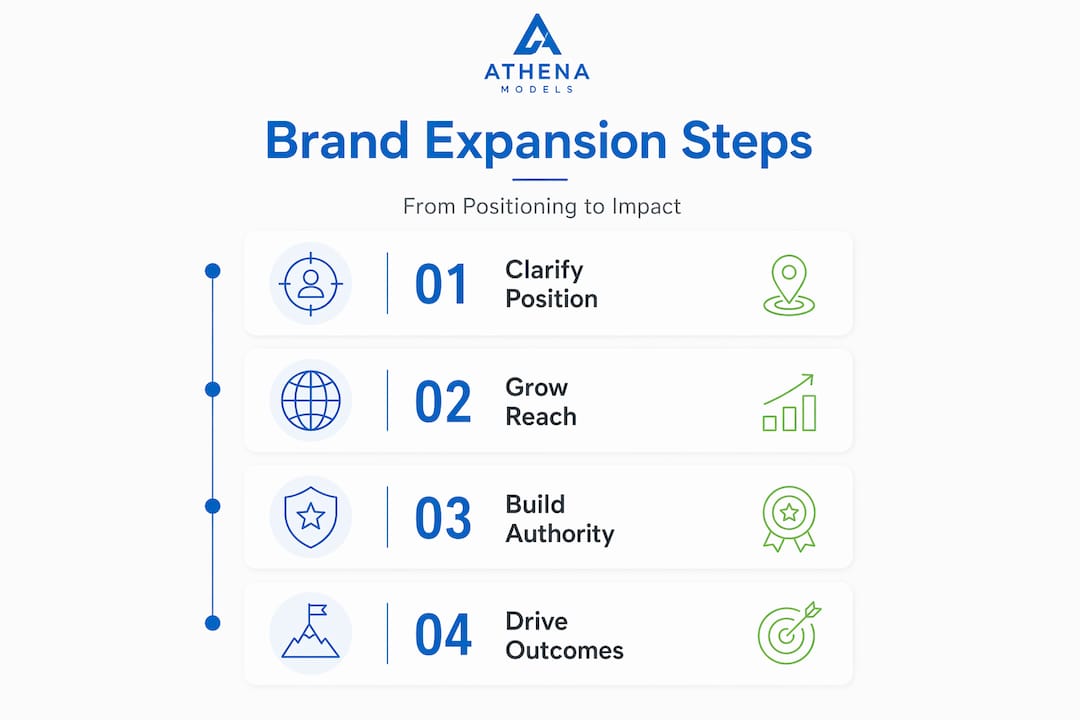
Personal brand expansion is not a content calendar. It's a growth system that scales three things at once: your reach, your influence, and your ability to convert attention into real business outcomes. Personal brand expansion is best understood as a revenue and relationship engine, where every activity connects directly to a measurable outcome.
There are four recognizable stages most entrepreneurs move through:
- Authority building: You're establishing credibility in a specific niche with a defined audience.
- Reach scaling: Your content and presence start attracting new audiences beyond your immediate network.
- Conversion activation: Your brand begins generating leads, partnerships, or direct revenue.
- Enterprise value creation: Your personal brand becomes a standalone asset that multiplies every business move you make.
The problem most people face is jumping to stage two or three before they've solidified stage one. Scaling reach without clear positioning just amplifies confusion.
Before you think about growth tactics, nail your positioning. The formula is straightforward: "I help [audience] achieve [outcome] through [method]." Clear positioning is the non-negotiable foundation before any scaling begins. Without it, every new follower you earn has no clear reason to stay, engage, or buy.
Pro Tip: Write your positioning statement in one sentence and test it by saying it out loud to someone unfamiliar with your work. If they immediately understand what you do and who you help, you're ready to scale.
A step-by-step system for brand growth
Guesswork is expensive. The entrepreneurs who grow their personal brands predictably use a repeatable system, not inspiration. Here's a framework that works:
- Set a 90-day campaign goal. Pick one specific outcome: 500 new email subscribers, 10 inbound consultation requests, or a speaking engagement. One goal. Not five.
- Break it into 30-day cycles. Each cycle focuses on one variable: content type, posting frequency, or a new engagement tactic. At the end of each cycle, review what moved the needle and adjust.
- Track three metric categories. Reach covers impressions and profile views. Engagement covers comments, shares, and saves. Conversion covers email signups, DMs from qualified leads, and meeting requests. Tracking reach, engagement, and conversion in 30-day cycles is the core of a practical expansion plan.
- Master one platform before adding another. Spend your first 90 days fully committed to one channel. Learn its algorithm, its culture, and what content format your audience responds to. Platform mastery before expansion prevents the dilution that kills most brand-building efforts.
- Allocate time with intention. Successful entrepreneurs spend 3 to 5 hours weekly on personal brand work, split across content creation, direct engagement, and relationship building. That's not a massive time commitment. It's a focused one.
- Build your conversion pipeline from day one. Don't wait until you have 10,000 followers to add a lead magnet or email list. An early conversion pipeline turns attention into business movement before your audience gets large enough to feel "worth it."
Pro Tip: Block a specific two-hour window each week labeled "brand work" in your calendar. Treat it like a client meeting. The creators who grow consistently protect this time fiercely.
Early results are visible sooner than most expect. Signs of brand expansion often appear within 4 to 8 weeks, with meaningful recognition typically developing between 3 and 12 months depending on consistency and platform fit.

Platform strategy and knowing when to scale
The biggest mistake entrepreneurs make with personal brand development is going wide too fast. They open accounts on five platforms, post inconsistently across all of them, and wonder why nothing gains traction. The answer is simple: spreading thin across platforms before mastering one dilutes your credibility and makes ROI attribution nearly impossible.
Here's a comparison of where most brands are versus where they should be at each stage:
| Stage | Common mistake | Better approach |
|---|---|---|
| Months 1 to 3 | Opening accounts on every platform | Commit fully to one primary platform |
| Months 4 to 6 | Chasing follower counts | Build email list and conversion path |
| Months 7 to 12 | Adding platforms out of FOMO | Add a second platform only after primary is converting |
| Year 2+ | Reposting the same content everywhere | Adapt content natively to each platform's culture |
When you're ready to evaluate whether you should expand to a second platform, ask yourself three questions:
- Is your primary platform generating consistent inbound leads or inquiries?
- Do you have a content system that runs without burning you out?
- Does your audience on platform one overlap with the audience you'd reach on platform two?
If you answer no to any of these, you're not ready. And that's fine. Personal branding creates trust faster than traditional marketing campaigns, but only when the signal is clear and consistent. Spreading across channels before you have that clarity just multiplies the noise.
Building a conversion pipeline early is not optional. Attention without a path to action is just entertainment. Whether your conversion goal is an email list, a discovery call, or a product sale, that pipeline needs to exist before you start scaling reach.
Tactics and mindset shifts for sustainable growth
The practical side of personal brand growth techniques comes down to a few habits that most people know but don't actually practice.
Treat your personal brand like a revenue-generating channel, not a side project. That mental shift changes how you prioritize it, how you measure it, and how seriously you take the work. Consistent, authentic content formats aligned with your natural strengths, whether that's writing, teaching, or video, outperform forced hype every time. If you hate being on camera, don't build your brand around video. Play to what you do well.
Use metrics to guide decisions, not vanity stats. Follower count is a lagging indicator. What you want to watch are engagement rate, reply quality, and conversion actions. These tell you whether your brand is actually resonating or just existing.
Engage meaningfully instead of just broadcasting. Comment thoughtfully on posts from people in your niche. Respond to every reply on your own content for the first 60 minutes after posting. Show up in conversations, not just in feeds. Brand-building requires continuous iteration on content and inbound lead data weekly, not quarterly.
Pro Tip: After every piece of content, note one thing that performed better than expected and one thing that underperformed. Over 90 days, these notes become a personal playbook that no generic advice can replicate.
Managing energy matters as much as managing time. Burnout is the number one killer of personal brand momentum. Build a content system that works at 70% capacity, not 100%, so you have room to stay consistent when life gets busy.
My honest take on why most brand expansion fails
I've worked with a lot of entrepreneurs on building and scaling their personal brands, and the pattern I see most often is this: people confuse activity with progress. They post daily, they join every trend, they spread across four platforms simultaneously, and after six months they're exhausted and no closer to their actual business goals.
What I've learned is that the importance of personal brand development only becomes real when you connect it to something you actually care about measuring. Not likes. Revenue. Leads. Speaking invitations. Partnership inquiries. When I started helping founders tie every brand activity to a specific KPI, the whole game changed. Suddenly, they stopped asking "what should I post today?" and started asking "what does my audience need to see to take the next step with me?"
The other thing I believe strongly: patience is a strategy. Meaningful brand recognition takes 3 to 12 months of consistent work. That timeline scares people off. But the ones who stay the course don't just build an audience. They build an asset. Consistent positioning and authentic content create brand equity that compounds over time in a way that paid ads simply cannot replicate.
My advice: pick one platform, write your positioning statement, set a 90-day goal, and measure ruthlessly. Everything else is a distraction until those fundamentals are locked in.
— Liam
How Athenaofm helps you build and expand your brand
If you've read this far and you're thinking "I know what to do, I just need the right system behind me," that's exactly the gap Athenaofm was built to close.
Athenaofm works with creators and entrepreneurs who are serious about scaling their personal brand with structure, not guesswork. The team brings marketing-focused systems, dedicated account management, and a clear strategic framework that connects your content and presence directly to business outcomes. Some creators working within the Athenaofm system have generated over $116k in a single month, not because they posted more, but because they had the right growth architecture in place. If you're ready to stop spinning your wheels and start building a brand that actually converts, exploring what Athenaofm offers is a smart next step.
FAQ
What is personal brand expansion?
Personal brand expansion is the process of strategically scaling your reach, authority, and business outcomes beyond your current audience. It goes beyond posting more content and focuses on connecting every brand activity to measurable results like leads, revenue, or partnerships.
How long does it take to see results from brand expansion?
Early signs of growth often appear within 4 to 8 weeks, while meaningful recognition typically develops between 3 and 12 months, depending on consistency and platform choice.
How many platforms should I be on when expanding my brand?
Start with one platform and commit to it for at least 90 days before adding another. Expanding too early dilutes your credibility and makes it harder to measure what's actually working.
What metrics should I track for personal brand growth?
Track three categories: reach (impressions, profile views), engagement (comments, shares, saves), and conversion (email signups, inbound leads, meeting requests). Follower count alone tells you very little about real brand health.
How much time does personal brand development require weekly?
Most successful entrepreneurs allocate 3 to 5 hours per week to personal brand work, split across content creation, direct engagement, and relationship building. Focused time consistently applied outperforms sporadic high-volume effort.