

Creator churn is the silent income killer that most OnlyFans agencies don't see coming until a creator walks out the door. If you're trying to reduce creator churn at your agency, the damage shows up fast: lost retainer revenue, wasted onboarding investment, and a roster that never quite stabilizes. The good news is that churn is largely predictable. With the right systems, metrics, and engagement workflows in place, you can minimize creator turnover before it becomes a pattern that threatens your entire operation.
Table of Contents
- Key takeaways
- How to reduce creator churn: signals and onboarding
- Fan engagement strategies that keep creators loyal
- Operational excellence that stabilizes creator income
- Using data to catch at-risk creators before they leave
- My take on what actually moves the needle
- How Athenaofm helps agencies stop losing creators
- FAQ
Key takeaways
| Point | Details |
|---|---|
| Track churn signals early | Engagement decay and payment delays appear weeks before a creator leaves. |
| Onboarding is infrastructure | A structured 90-day onboarding program directly reduces early-stage dropout rates. |
| Respond fast to fans | Creators whose fans get replies within minutes retain higher engagement and lower churn. |
| Use health scoring | Weighted KPI models let you intervene months before a creator actually churns. |
| Standardize delivery | Documented processes protect retention even when account managers change. |
How to reduce creator churn: signals and onboarding
Before you can fix churn, you need to see it coming. Most agencies react to churn after it happens. The creators who are about to leave give you signals weeks in advance, and if you're not watching the right metrics, you'll miss every one of them.
The most reliable early warning signals include:
- Declining message response rates from creators or their fans
- Missed payment milestones or repeated card failures
- Reduced content submission frequency compared to the first 30 days
- Decreased login activity across the creator's account
- Sentiment shifts in creator check-in calls, moving from enthusiastic to flat
Behavioral signals appear 2 to 3 weeks before a cancellation event. That's your window. Once you know what to look for, you can act before the conversation turns into a resignation.
Onboarding is where most agencies lose creators without realizing it. Onboarding friction at contract, payment, and compliance stages causes delays and dissatisfaction that escalate creator churn within the first 90 days. International wire transfers alone can cost $25 to $50 per transaction and take three to five days. That kind of friction, right at the start of a relationship, sets a negative tone that's hard to reverse.
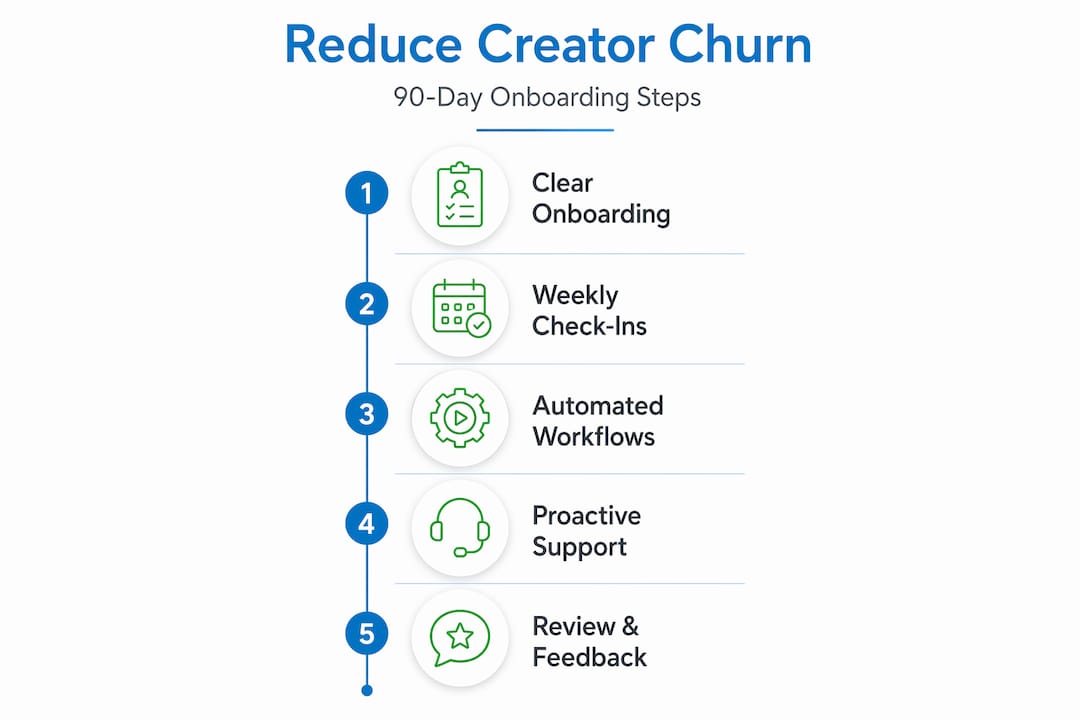
The fix is to treat onboarding as infrastructure, not paperwork. Build a 90-day onboarding program with templated workflows, automated payment scheduling, and clear milestone check-ins at days 7, 30, and 60. Pair each creator with a dedicated account manager from day one so there's a consistent human point of contact.
Pro Tip: Set up a CRM tag for every creator in their first 90 days. Flag any creator who misses two consecutive check-ins for an immediate outreach call. Early intervention at this stage costs almost nothing and saves the relationship.
| Warning signal | What it predicts | Recommended action |
|---|---|---|
| Engagement decay | Creator disengagement within 2 to 3 weeks | Schedule a check-in call immediately |
| Payment failure | Involuntary churn risk | Trigger automated retry and card update request |
| Reduced content output | Burnout or dissatisfaction | Offer content planning support |
| Missed check-in meetings | Relationship breakdown | Escalate to senior account manager |
Fan engagement strategies that keep creators loyal
Here's something most agencies get wrong. Creator retention isn't just about how you treat creators. It's about how their fans behave. When fan revenue drops, creators blame the agency. When fan engagement is strong, creators stay. Your fan engagement strategy is directly tied to your ability to boost creator retention.
The first 72 hours after a fan subscribes are the highest-leverage period for retention. A personalized welcome message sent within that window, combined with an early pay-per-view offer, sets the engagement trajectory for the entire subscription. Miss that window and you're already playing catch-up.
Effective engagement workflows segment fans into three tiers:
- Newbies (subscribed within 7 days): Send a personalized welcome sequence, introduce the creator's content style, and offer a low-cost PPV to trigger the first purchase habit.
- Spenders (active buyers): Prioritize with exclusive content drops, early access offers, and direct creator messages that feel personal, not templated.
- VIP fans (high-spend, long-tenure): Assign dedicated attention, custom content requests, and milestone acknowledgments like anniversary messages.
Fans who receive replies within minutes retain higher engagement rates and generate lower churn across the creator's account. Response time is not a soft metric. It's a revenue driver.
The challenge for agencies is maintaining that response speed at scale without burning out creators. The answer is an AI-human hybrid model. Use AI to draft initial responses based on the creator's established voice and tone, then have a human reviewer approve or lightly edit before sending. This keeps response times under five minutes without requiring the creator to be online around the clock.
Pro Tip: Build a message library of 50 to 100 voice-matched responses for each creator covering common fan questions, compliments, and PPV pitches. This library becomes the foundation for both AI-assisted messaging and new team member training.
Operational excellence that stabilizes creator income
Creators don't just leave because they're unhappy with results. They leave because the experience of working with your agency feels chaotic. Missed deadlines, inconsistent reporting, and unclear communication create anxiety that compounds over time. Anxiety leads to churn.

Delivery issues cost agencies $12,000 to $30,000 annually per agency in rework and margin erosion. That's not a creative problem. It's an operational one. The solution is standardization at every stage of the delivery loop.
Building a delivery system creators trust
Start with standardized content briefs. Every piece of content your agency produces or schedules should originate from a documented brief that includes the creator's brand voice, content category, posting schedule, and performance benchmarks. No brief, no production.
Add QA checkpoints before anything goes live. A two-step review process, one from the account manager and one from a senior reviewer, catches errors before the creator sees them. This matters because operational consistency with standardized delivery and reporting reduces churn by creating a trustworthy, stable experience regardless of which account manager is handling the account.
Staff turnover is a churn amplifier. When a creator's account manager leaves, the creator often considers leaving too. Structured handoffs with documented account histories, active campaign notes, and relationship context prevent that risk. The creator should barely notice the transition.
| Operations maturity level | Creator experience | Retention outcome |
|---|---|---|
| Low (ad hoc processes) | Inconsistent, reactive, stressful | High churn within 6 months |
| High (standardized systems) | Predictable, transparent, confident | Low churn, longer retainer tenure |
Pro Tip: Schedule a monthly "state of account" report for every creator, even when performance is strong. Proactive reporting signals competence and builds the kind of trust that makes creators stay through slow periods.
Using data to catch at-risk creators before they leave
You can't report your way out of churn. Leading indicators predict churn three to six months in advance, but only if you're measuring the right things and acting on them. Most agencies track lagging indicators like monthly revenue and subscriber count. By the time those numbers drop, the creator is already mentally gone.
Here's how to build a health monitoring system that actually prevents churn:
- Define your core metrics. Track email response rate, meeting attendance rate, content submission rate, payment timeliness, and sentiment score from check-in calls. These five metrics cover the financial, operational, and relational dimensions of creator health.
- Assign weights to each metric. Not all signals carry equal weight. Payment delays are a stronger churn predictor than a single missed meeting. A weighted scoring model might assign payment timeliness 30% of the total score, response rate 25%, and the remaining three metrics 15% each.
- Build tiered risk classifications. Score each creator weekly. Green (80 to 100) means healthy. Yellow (60 to 79) means watch closely. Red (below 60) means intervene immediately with a structured save conversation.
- Set automated alerts. Your CRM should flag any creator who drops from green to yellow in a single week. That kind of rapid decline is a stronger signal than a gradual drift.
- Run structured save conversations. When a creator hits red, don't send an email. Call them. Have a prepared framework that acknowledges their concerns, presents specific improvements you're committing to, and offers a tangible incentive to stay, whether that's a fee adjustment, a new service, or a dedicated escalation contact.
A layered early warning system combining multiple engagement and financial metrics allows targeted retention interventions months before churn occurs. The agencies that decrease content creator dropout rates the most aren't the ones with the best creative. They're the ones with the best data habits.
Automated payment retries and proactive card update notifications also play a major role. Involuntary churn from payment failures is entirely preventable with the right infrastructure, yet most agencies treat it as an afterthought.
My take on what actually moves the needle
I've watched agencies with genuinely talented teams lose creators at a rate that made growth impossible. The pattern is almost always the same. They focus on creative quality, which matters, and completely neglect the operational and relational infrastructure that makes creators feel secure enough to stay.
In my experience, the single biggest lever for creator retention isn't better content or higher earnings. It's predictability. Creators who know exactly what to expect from their agency, when reports arrive, how quickly messages get answered, what happens when something goes wrong, stay longer than creators who earn more but feel uncertain about the relationship.
I've also seen agencies try to solve churn with automation alone. Pure automation kills the personal connection that keeps VIP fans spending and creators feeling valued. The AI-human hybrid model I described earlier isn't just a productivity hack. It's a retention philosophy. Use technology to handle volume, and use humans to handle moments that matter.
The hardest lesson I've learned is that most churn is decided long before the creator says anything. By the time someone tells you they're leaving, they've already made the decision. That's why the health scoring system and the early warning signals matter so much. You're not trying to win a conversation. You're trying to prevent the conversation from ever becoming necessary.
If you want to build an agency for creator loyalty that lasts, start with onboarding, standardize your delivery, and watch your data like it's your most important employee. Because it is.
— Liam
How Athenaofm helps agencies stop losing creators
If the systems described in this article sound like exactly what your agency needs but building them from scratch feels like a full-time job, that's where Athenaofm comes in.
Athenaofm was built specifically for OnlyFans creators and agencies that are serious about sustainable growth. The platform combines dedicated account management, structured onboarding programs, automated fan engagement workflows, and the kind of operational infrastructure that turns chaotic creator relationships into stable, growing retainers. Some creators working within the Athenaofm system have reached over $116,000 in a single month, not because of luck, but because of the systems behind them. If you're ready to increase creator satisfaction and build a roster that actually stays, explore what Athenaofm offers and see whether it fits where you want to take your agency.
FAQ
What causes the most creator churn at agencies?
Operational failures like inconsistent communication, payment delays, and unclear delivery processes drive more creator churn than creative performance issues. Creators leave when the agency experience feels unpredictable or chaotic.
How early can you detect creator churn risk?
Leading indicators predict churn three to six months before it happens. Metrics like declining response rates, missed meetings, and payment delays are reliable early signals when tracked consistently.
What is the most important window for fan retention?
The first 72 hours after a fan subscribes are the highest-leverage period. Personalized welcome messages and early pay-per-view offers sent within that window significantly improve long-term retention.
How does standardized delivery reduce creator churn?
Standardized delivery processes create consistent, predictable experiences that build creator trust. When outcomes don't depend on a single account manager, staff changes stop triggering creator departures.
How should agencies handle at-risk creators?
Build a weighted health score using five to seven metrics and classify creators into green, yellow, and red tiers. When a creator hits red, initiate a structured phone call, not an email, with a prepared framework for addressing concerns and committing to specific improvements.